|
| |
| |
|---|
|
| |
| |
|---|
Truck Parts & Their Functions
Engine And Exhaust
| Item | Sample Picture | Function |
| Aftertreatment System, EPA07 |  | The aftertreatment system (ATS) includes all the piping and equipment between the engine turbocharger outlet and the tip of the exhaust pipe. It corresponds to the exhaust system on pre-EPA07 vehicles, but includes an aftertreatment device (ATD) instead of a muffler and other equipment. Inside the ATD, the exhaust emissions pass first through the diesel oxidation catalyst where they are chemically treated, then through the diesel particulate filter (DPF), where solid particles are trapped. The remaining particulates are almost completely vaporized in the DPF, in a process called regeneration (regen). Soot from additives in the engine oil cannot be vaporized, but it is burned to ash and held in the DPF. When the ash buildup is heavy enough to begin clogging the DPF, the DPF must be removed from the vehicle and physically cleaned in special processes specified by the engine manufacturers. Using low-ash oil extends the time required for DPF cleaning, and only low-ash oil should be used in EPA07 engines .Operation of the ATS is controlled by an electronic control module (ECM). |
| Aftertreatment System, EPA10 and Newer | 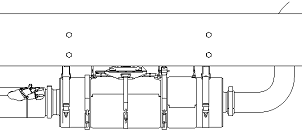 | Inside the Aftertreatment device (ATD), the exhaust first passes through the diesel oxidation catalyst (DOC) where combustion gasses are chemically broken down to water and carbon dioxide, then through the DPF, where solid particles are trapped. The soot is reduced to ash during regeneration, and the ash is collected in the DPF until the DPF is full. If the exhaust temperature is high enough, the trapped soot is reduced to ash in a process called passive regen, which occurs as the vehicle is driven normally. Passive regen, however, cannot always keep the DPF clean, so the ATD must also periodically undergo active regen. During active regen, extra fuel is injected into the exhaust stream to superheat and reduce the soot trapped in the DPF to ash. After exhaust gases leave the ATD, a controlled quantity of diesel exhaust fluid (DEF) is injected into the exhaust stream. In the presence of heat, DEF is converted to ammonia gas, which reacts with NOx in the SCR chamber to yield nitrogen and water vapor, which exit through the tailpipe. |
| Block Heater |  | An engine block heater keeps the engine coolant about 80°F (27°C) warmer than the ambient air temperature. In cold weather, the heater helps engine starting and reduces wear on the piston walls. When starting the engine, the diesel fuel normally ignites on the compression stroke of each piston, when the compressed air within the cylinder reaches about 725°F (385°C). However, during cold-weather starts, the heat of the compressed air dissipates into the surrounding engine block so the diesel fuel may never reach the temperature it needs to ignite. Using the engine block heater, the engine block is already warm so heat is held in the cylinder to ignite the diesel fuel. To reduce engine wear, the block heater warms the oil film on the piston walls and reduces piston drag caused by cold oil film. |
| DEF Tank | 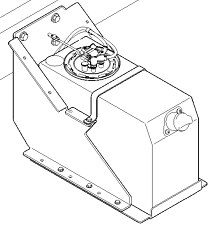 | The Environmental Protection Agency (EPA) mandated that all engines built after December 31, 2009 must reduce the level of emissions exhausted by the engine to 0.2 grams per brake horsepower hour (g/bhp-hr) of nitrogen oxides (NOx). To meet the EPA10 requirements, Daimler Trucks North America is using technology known as Selective Catalytic Reduction (SCR) in the exhaust aftertreatment system (ATS). The SCR process requires the introduction of diesel exhaust fluid (DEF) into the exhaust stream. DEF is colorless, non-toxic, and biodegradable. In the ATS, the exhaust gases pass through the ATD, then are treated with precisely-controlled quantities of DEF, and then pass into the SCR catalyst. DEF consumption is dependent on vehicle operation. |
| Drive Belt |  | The drive belt, also known as the fan belt, provides power to many important components located near the front of the engine. The drive belt powers the alternator, water pump, power steering pump, and AC compressor. Each of these components contains a pulley where the drive belt wraps around. |
| Electronic Throttle Pedal |  | The suspended electronic throttle pedal is designed to provide an electrical signal to an engine control module in response to the driver's demand for engine power. |
| Engine Mounts |  | Three mounts support the engine and transmission, holding a total of almost 1800 lb (816 kg). Two of the engine mounts support the rear of the engine and transmission assembly. The third supports the front of the engine/transmission assembly. Each of the rear engine mounts is bolted to the inside of the frame rail near the flywheel housing. These mounts support legs which are bolted to the flywheel housing. Engines use a rear engine leg that rests flat on the mount. |
| Exhaust Gas Recirculation | Exhaust Gas Recirculation (EGR) is an emission control technology allowing significant NOx emission reductions from most types of diesel engines: from light-duty engines through medium- and heavy-duty engine applications right up to low-speed, two-stroke marine engines. | |
| Muffler Exhaust System |  | The exhaust system routes hot exhaust gas away from the cab, and reduces engine exhaust noise. S2 chassis have a horizontally mounted muffler on the right side of the vehicle and are available with a horizontal outlet. |

